Essential Guide · Updated January 2025
Transporting Exotic Pets Across State Lines: The Complete Legal Guide
Moving, traveling, or shipping an exotic pet across state lines triggers a different set of legal requirements than simple ownership. Here is what the law says about interstate transport.
The Core Rule: State Law Applies at the Border
When you cross a state line with an exotic pet, the law of your destination state — and each state you pass through — applies immediately. There is no federal "in transit" exemption that allows you to carry a prohibited species through a state that bans it, except in limited circumstances for licensed commercial transporters.
In practice, enforcement of "passing through" situations is rare for private individuals in vehicles. But it is a genuine legal risk, particularly for states with active enforcement (Hawaii, California, New York) and particularly if you stop overnight or are pulled over for unrelated reasons.
Moving to a New State Permanently
This is the highest-stakes scenario. If you are relocating to a state that bans your exotic pet, you cannot legally bring the animal with you. Your options:
- Rehome before moving: Find a legally permitted owner in your current state or another permissive state before your relocation date.
- Place with a licensed sanctuary or facility: Many exotic animal sanctuaries will accept animals, though placement is not guaranteed and may involve fees.
- Choose a different state: If your exotic pet is central to your life, this is worth considering in your relocation decision.
There is no "moving exemption" that allows you to bring a prohibited animal to a new state and grandfather its status. The animal becomes illegally possessed the moment you enter the prohibited state.
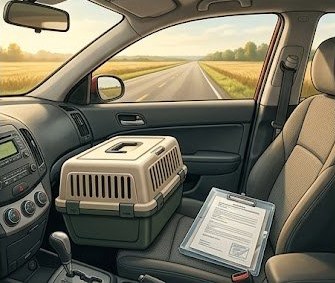
Road Trips and Multi-State Travel
For shorter travel with an exotic pet, the key considerations are:
- Map your route and check the legal status of every state on your planned path, not just your origin and destination
- Keep all ownership documentation — bill of sale, captive-bred certification, any state permits — accessible during travel
- Some states require a Certificate of Veterinary Inspection (CVI) for importing any animal, even temporarily. Florida, for example, requires a CVI for animals entering the state
- If your animal is legal in your destination but you pass through a banned state, staying on major interstate highways and not stopping overnight reduces (but does not eliminate) legal risk
Air Travel With Exotic Pets
Airline policies on exotic pets are separate from — and often more restrictive than — legal status. Most major US airlines do not allow exotic mammals in the cabin or as checked baggage, regardless of legality. Animals that are typically accepted in cargo by some airlines include: domestic dogs, cats, and certain birds with proper documentation.
If you need to transport an exotic pet by air, specialty animal transport services exist that are USDA-licensed for animal transport. These services have the appropriate carrier documentation and experience with health certificate requirements.
Interstate Commerce and the Lacey Act
Buying or selling exotic animals across state lines is interstate commerce and triggers Lacey Act jurisdiction. If you purchase an animal from a seller in another state, the animal must be legally possessed in both states — both the state it was shipped from and the state it was shipped to. A seller in Texas shipping a capybara to a Pennsylvania buyer is engaged in interstate commerce; the transaction must comply with both states' rules.
Health Certificates for Interstate Transport
Many states require a Certificate of Veterinary Inspection (CVI, also called a health certificate) for animals imported into the state. This is a document signed by a USDA-accredited veterinarian stating that the animal appears healthy and is free from signs of communicable disease. Requirements vary:
- Some states require CVIs for all mammals entering the state
- Some require CVIs only for certain species
- CVIs are typically valid for 30 days from issuance
- The cost is typically $50–$150 from an accredited vet
If you are purchasing from an out-of-state seller, ask them to confirm whether your state requires a CVI and arrange for one before shipment.
Frequently Asked Questions
ISENVO Pet Microchip Scanner — 134.2kHz / 125kHz, 15-Digit Reader
Many state permits — including Ohio's Dangerous Wild Animal registration, Florida's Class II license, and Texas DWA registration — require microchipping as a condition of legal ownership. This rechargeable RFID scanner reads both 134.2kHz and 125kHz ISO chips, displays the full 15-digit ID, and works on all exotic mammals. $34.99 · Prime eligible.
View on Amazon — $34.99 →As an Amazon Associate, we earn from qualifying purchases.