Species Guide · Updated January 2025
Serval Cat Ownership Laws by State (2025)
Servals are legal in roughly 16 states but banned in most others. This guide covers every state's status, Florida's Class II licensing requirements, and the history behind Ohio's 2012 ban.
Overview: Serval Cat Legality in the US
Servals (Leptailurus serval) are medium-sized African wild cats weighing 20–40 lbs, known for their spotted coats and extraordinary jumping ability. They are among the most-regulated exotic cats in the United States, legal in roughly 16 states with various permit requirements, and banned in the majority of states that have enacted exotic animal legislation.
States Where Servals Are Legal (With or Without Permit)
| State | Status | Notes |
|---|---|---|
| Alabama | Legal | No state permit required for servals specifically; verify local rules |
| Florida | Permit | Class II Wildlife License from FWC required; annual inspection, $140/yr fee |
| Idaho | Legal | No state-level restrictions on servals |
| Indiana | Legal | Legal; verify county-level rules |
| Maine | Permit | Importation permit required from ME Dept. of Agriculture |
| Montana | Legal | No state restrictions on servals |
| Nevada | Legal | No state permit required; one of the clearest serval states |
| North Dakota | Legal | No restrictions |
| Oklahoma | Legal | No state permit required |
| Pennsylvania | Permit | Exotic Wildlife Possession Permit from PA Game Commission required |
| South Carolina | Legal | No state-level ban |
| South Dakota | Legal | No restrictions |
| Texas | Permit | Not on TX Dangerous Wild Animal list; may need county-level approval |
| Wisconsin | Permit | Captive wildlife license required from WI DNR |
| California | Banned | All wild cats banned under CA Fish & Game Code |
| Georgia | Banned | Wild cats prohibited; servals classified as dangerous wild animals |
| Massachusetts | Banned | All wild cats prohibited |
| New York | Banned | Wild cats prohibited under ECL |
| Ohio | Banned | Servals banned post-2012 Dangerous Wild Animal Act |
| Most other states | Banned | The majority of states ban serval ownership; check your state specifically |
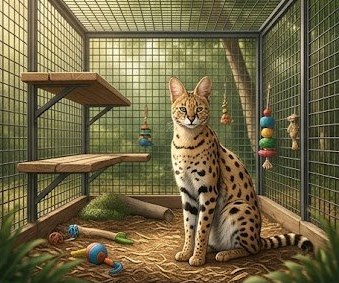
Florida's Class II License for Servals
Florida permits serval ownership under a Class II Wildlife License — a stricter tier than the Class III license required for smaller exotics. Class II animals are defined as animals that can pose a "significant danger" to people, and the licensing requirements reflect this: annual facility inspections, specific cage size and construction standards (servals require a minimum 12x12x8 ft outdoor enclosure with reinforced roof), and an annual fee of $140 as of 2024.
Class II applicants must also demonstrate relevant experience with the species — typically 1,000+ hours documented experience with wild or exotic cats prior to receiving a Class II license for personal possession. This experience requirement is the most common barrier for new applicants in Florida.
The Ohio Serval Ban: Zanesville's Legacy
Ohio's 2012 Dangerous Wild Animal Act was passed in direct response to the Zanesville incident of October 2011, when Terry Thompson released 56 exotic animals — including servals, lions, and bears — before taking his own life. Law enforcement was forced to shoot 49 of the escaped animals. The incident galvanized Ohio's previously lax exotic animal regulations into one of the most restrictive frameworks in the country.
Under the 2012 Act, servals are classified as Restricted Dangerous Wild Animals. Individuals who owned servals before the law's effective date could grandfather their animals through a registration process, but new ownership is prohibited. Grandfathered animals cannot be bred, sold within Ohio, or replaced when they die.
USDA Requirements for Serval Owners
If you exhibit your serval publicly — even informally, such as allowing people to visit your property to see the animal — you may be required to obtain a USDA Animal Welfare Act Class C Exhibitor license. The USDA's definition of "exhibition" is broad and has been applied to private individuals who charge admission or regularly allow public access to their animals. Private possession for personal companionship, with no public exhibition, does not require USDA licensing.
Frequently Asked Questions
ISENVO Pet Microchip Scanner — 134.2kHz / 125kHz, 15-Digit Reader
Many state permits — including Ohio's Dangerous Wild Animal registration, Florida's Class II license, and Texas DWA registration — require microchipping as a condition of legal ownership. This rechargeable RFID scanner reads both 134.2kHz and 125kHz ISO chips, displays the full 15-digit ID, and works on all exotic mammals. $34.99 · Prime eligible.
View on Amazon — $34.99 →As an Amazon Associate, we earn from qualifying purchases.